
Web Design Company Nagpur: Reviews & Contact Number (2026)
15 Oct, 2026
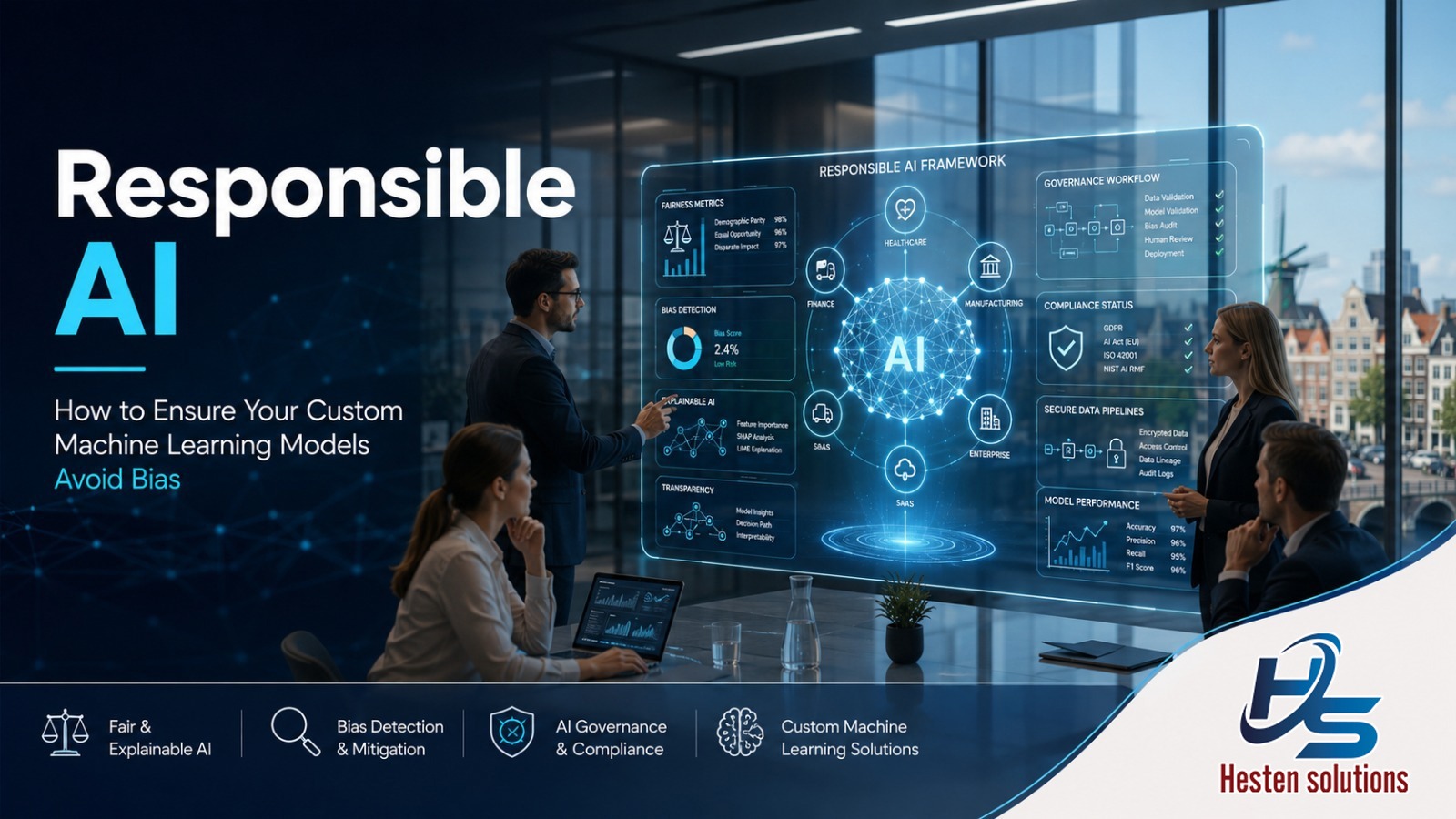
Artificial Intelligence is transforming industries across the Netherlands. From intelligent automation and predictive analytics to fraud detection and customer support, businesses are integrating machine learning into critical decision-making processes faster than ever before.
However, as AI adoption grows, so does the responsibility to ensure these systems are fair, transparent, and trustworthy.
A machine learning model is only as reliable as the data and decisions behind it. If hidden bias enters the development process, AI can unintentionally discriminate against individuals, produce inaccurate predictions, and expose organizations to regulatory, financial, and reputational risks.
For businesses operating in Europe, responsible AI is no longer simply a best practice. With evolving regulatory frameworks such as the European Union AI Act and existing GDPR obligations, organizations are expected to demonstrate that their AI systems are developed, tested, and monitored responsibly.
Whether you're creating an AI-powered recruitment platform, a financial risk assessment tool, a healthcare solution, or an enterprise SaaS application, eliminating bias should be an integral part of your AI strategy not an afterthought.
In this guide, we'll explore:
By implementing these strategies, organizations can create AI solutions that improve decision-making while building customer trust and supporting sustainable business growth.
Artificial intelligence is no longer limited to research labs or large technology companies. Today, businesses of every size are using AI to automate workflows, personalize customer experiences, detect fraud, forecast demand, and optimize operations.
These systems increasingly influence important decisions affecting employees, customers, suppliers, and business partners.
When AI decisions become biased, the consequences extend far beyond technical errors.
A biased recruitment algorithm might consistently overlook qualified candidates.
A lending model may unintentionally reject applicants from specific demographics.
A healthcare prediction system could perform better for one population than another.
A customer recommendation engine might reinforce unfair purchasing patterns.
Each of these situations affects customer trust, business performance, and legal compliance.
For organizations in the Netherlands, where digital innovation is closely linked with ethical governance and regulatory accountability, responsible AI has become a strategic business priority.
Companies that invest in fairness, transparency, and continuous model improvement gain significant competitive advantages:
Responsible AI is therefore not about limiting innovation—it is about ensuring innovation delivers reliable, explainable, and equitable outcomes for everyone.
Artificial Intelligence has the potential to transform business operations, but even the most advanced machine learning (ML) models can produce unfair or inaccurate results if bias is introduced during development. Contrary to popular belief, bias isn't created by AI itself—it's usually a reflection of the data, assumptions, and decisions made throughout the machine learning lifecycle.
For businesses in the Netherlands investing in custom AI solutions, understanding where bias originates is the first step toward building responsible, compliant, and trustworthy AI systems.
AI bias occurs when a machine learning model consistently produces unfair, inaccurate, or discriminatory outcomes for certain individuals or groups due to flaws in the data, model design, or deployment process.
Instead of making objective decisions, the AI learns patterns that may unintentionally favor or disadvantage specific users.
For example:
These issues rarely stem from malicious intent—they are often the result of hidden patterns within data or incomplete development practices.
The quality of an AI model depends on the quality of its training data. If the dataset contains historical inequalities, missing information, or unbalanced representation, the model will learn those patterns.
Imagine building a customer credit scoring model using ten years of historical loan approvals. If past lending decisions unintentionally favored certain customer groups, the AI may continue making similar recommendations even when applicants have comparable financial profiles.
Historical bias exists even when data is technically accurate.
If previous business decisions reflected outdated policies, social inequalities, or operational preferences, AI models may replicate those historical patterns instead of making objective decisions.
A recruitment platform trained on previous hiring records might learn that candidates from certain universities were selected more frequently—not because they were inherently better, but because of historical recruitment preferences.
Without intervention, the AI may continue prioritizing similar applicants.
Sampling bias occurs when certain customer groups, industries, or user behaviors are overrepresented while others receive little or no representation.
This creates models that perform well for one segment but poorly for others.
A retail recommendation engine trained primarily on urban purchasing behavior may generate inaccurate recommendations for customers living in smaller towns or rural areas.
Sometimes bias is introduced by choosing the wrong input variables.
Even if sensitive information such as age, gender, or ethnicity is removed, other variables may indirectly reveal similar information.
These are known as proxy variables.
Using postal codes alone may unintentionally reflect income levels, demographic distributions, or geographic inequalities.
The AI may appear neutral while still making biased decisions.
Responsible AI requires careful evaluation of every feature used during model development.
Many supervised machine learning models depend on human-labeled data.
If human reviewers apply inconsistent standards or unconscious preferences during labeling, the AI learns those inconsistencies.
An AI system trained to identify high-performing employees could become biased if previous performance reviews were subjective rather than based on measurable outcomes.
Consistency in annotation guidelines and quality assurance processes is essential.
Even with high-quality data, the learning algorithm itself can amplify small differences between groups.
Some optimization techniques naturally prioritize overall accuracy instead of fairness across different user segments.
For example, an AI model achieving 95% overall accuracy may still perform significantly worse for a smaller population if fairness metrics are ignored during evaluation.
Responsible AI development requires balancing performance with fairness—not simply maximizing accuracy.
Bias doesn't stop after model training.
Real-world environments change continuously.
Customer behavior evolves.
Market conditions shift.
Business processes improve.
If an AI model isn't regularly monitored and retrained, performance may gradually decline for certain groups.
An e-commerce recommendation system trained before major changes in consumer behavior may provide increasingly irrelevant recommendations over time unless it adapts to new purchasing patterns.
Continuous monitoring is therefore an essential component of responsible AI.
Consider a financial technology company developing an AI-powered loan approval system.
Initially, the model demonstrates excellent predictive performance.
However, after deployment, analysts discover that approval rates vary significantly between equally qualified applicants.
An investigation reveals multiple contributing factors:
By identifying these issues early, the organization retrained the model with more representative data, revised feature selection, implemented fairness testing, and established ongoing monitoring.
The result was a more transparent, equitable, and trustworthy AI solution that better served both the business and its customers.
For organizations operating in the Netherlands and across the European Union, biased AI systems present more than technical challenges.
They can lead to:
With regulations such as the EU AI Act and GDPR placing greater emphasis on accountability, transparency, and risk management, businesses must demonstrate that their AI systems are developed responsibly from the outset.
Responsible AI is no longer just a competitive advantage—it is becoming a business necessity.
Machine learning bias is rarely caused by a single mistake. Instead, it often results from a combination of data quality issues, historical patterns, feature selection, human decisions, algorithm design, and insufficient monitoring.
Organizations that proactively identify and address these challenges are better positioned to build AI systems that are fair, transparent, reliable, and aligned with evolving regulatory expectations.
At Hesten Solutions Pvt. Ltd., we help businesses design and develop custom AI solutions with Responsible AI principles embedded throughout the entire machine learning lifecycle—from data preparation and model development to deployment, monitoring, and continuous improvement. This approach enables organizations to innovate with confidence while maintaining trust, compliance, and long-term performance.
Building a custom machine learning model is only the beginning of an AI journey. Even when trained on large datasets using advanced algorithms, AI systems can still make unfair or inaccurate decisions if different forms of bias remain undetected.
Many organizations assume bias only relates to race or gender. In reality, bias can appear throughout the entire AI lifecycle—from collecting data to making predictions in production.
Understanding these different types of bias enables businesses to develop AI solutions that are more accurate, transparent, and aligned with Responsible AI principles.
Historical bias occurs when AI learns from decisions made in the past that no longer reflect today's business values, customer expectations, or regulations.
Although historical data may be accurate, it can still contain outdated patterns that AI unintentionally repeats.
A financial institution develops a loan approval model using records from the last ten years.
Previous lending decisions favored applicants with long employment histories, making it harder for freelancers and entrepreneurs to receive approval.
Without intervention, the AI continues following these historical patterns despite today's changing workforce.
Representation bias occurs when certain customer groups are overrepresented while others have little or no presence within the training dataset.
As a result, the AI performs well for one group but poorly for another.
A healthcare AI system is trained primarily using patient data from one demographic group.
When deployed nationally, prediction accuracy decreases significantly for patients who were underrepresented during training.
Sampling bias occurs when the collected data fails to represent real-world conditions.
This often happens because organizations collect information from only one source or one type of customer.
An e-commerce recommendation engine is trained using purchases from premium customers only.
After deployment, recommendations become less relevant for budget-conscious shoppers.
Measurement bias appears when data itself is inaccurate, inconsistent, or measured differently across sources.
Even high-quality AI algorithms cannot compensate for unreliable input data.
A logistics company uses manually entered delivery times from different warehouses.
Some teams record exact arrival times while others estimate delivery windows.
The AI learns inconsistent patterns, reducing forecasting accuracy.
Supervised machine learning depends on labeled data.
If human reviewers apply inconsistent standards or subjective opinions during labeling, the model inherits those inconsistencies.
An HR platform uses managers' previous performance ratings to train an employee evaluation model.
Different managers score employees differently despite similar performance.
The AI learns inconsistent evaluation criteria.
Sometimes bias is introduced during model optimization rather than through data.
Many algorithms prioritize overall prediction accuracy while unintentionally reducing fairness for smaller groups.
A fraud detection model correctly identifies most fraudulent transactions.
However, it produces significantly more false positives for small businesses because those cases represent a smaller portion of the training data.
Overall accuracy appears excellent, yet fairness suffers.
Even a well-trained AI model can become biased after deployment.
Customer behavior changes.
Markets evolve.
Business processes improve.
If AI models remain unchanged, prediction quality gradually decreases.
A customer support AI is trained before a company launches several new products.
Months later, customers ask completely different questions.
Without retraining, response quality declines, reducing customer satisfaction.
A diagnostic AI performs exceptionally well for adult patients but struggles with pediatric cases because children's medical records were underrepresented during training.
Business Impact: Reduced diagnostic accuracy, patient safety concerns, and increased regulatory scrutiny.
An AI-powered credit assessment system unintentionally rejects qualified applicants due to historical lending patterns embedded in the training data.
Business Impact: Lower customer trust, compliance risks, and missed business opportunities.
An AI recruitment platform favors candidates whose profiles resemble previous hires rather than evaluating current skills objectively.
Business Impact: Reduced workforce diversity and missed talent.
A recommendation engine promotes products based only on previous purchasing behavior, limiting product discovery and reinforcing existing buying patterns.
Business Impact: Lower customer engagement and reduced revenue potential.
A predictive maintenance model trained on one production facility performs poorly when deployed across factories with different equipment and operating conditions.
Business Impact: Increased downtime and inaccurate maintenance scheduling.
As organizations across the Netherlands accelerate AI adoption, they must also demonstrate that automated decisions are fair, explainable, and accountable.
The EU AI Act introduces a risk-based framework for AI systems, requiring organizations—particularly those deploying high-risk AI—to implement appropriate governance, documentation, transparency, and ongoing monitoring. Alongside this, the GDPR continues to apply whenever AI systems process personal data, emphasizing lawful processing, data minimization, and individual rights.
Ignoring bias can lead to:
Organizations that proactively identify and mitigate bias are better positioned to build trusted AI solutions that deliver sustainable value.
Before deploying your AI solution, ask:
If the answer to any of these questions is "No," further validation is recommended before production deployment.
Bias can enter an AI system through data, labels, algorithms, or deployment—not just during model training. Responsible AI requires continuous attention throughout the entire machine learning lifecycle.
At Hesten Solutions, we design custom AI and machine learning solutions with fairness, transparency, and long-term governance built in from the start. By combining robust data practices, continuous monitoring, and Responsible AI principles, we help businesses in the Netherlands develop AI systems that are not only intelligent but also trustworthy, compliant, and built for sustainable growth.
Building a responsible AI system goes beyond choosing the right algorithm. It requires a structured framework that embeds fairness, transparency, accountability, and continuous improvement into every stage of the machine learning lifecycle.
For businesses in the Netherlands, this approach not only improves AI performance but also helps align projects with evolving European regulations, including the EU AI Act and GDPR, while strengthening customer trust and business resilience.
Below is a practical framework that organizations can use to develop custom machine learning models that are both accurate and responsible.
Every successful AI project starts with a well-defined objective—not with data or algorithms.
Instead of asking:
"Can we use AI?"
Ask:
"What business problem are we trying to solve?"
Clearly defining the purpose helps prevent unnecessary data collection, reduces project complexity, and establishes measurable success criteria.
Instead of building an AI system to "improve customer service," define a specific goal such as:
A clear objective ensures the AI is designed to solve a real business challenge rather than becoming a technology experiment.
Machine learning models learn from the data they receive. If the data is incomplete, outdated, or unbalanced, the AI will reflect those weaknesses.
High-quality datasets should include:
Organizations should avoid relying solely on historical data if business processes or customer behavior have changed significantly.
✔ Use multiple trusted data sources.
✔ Remove duplicate records.
✔ Correct missing values where appropriate.
✔ Eliminate inaccurate or inconsistent information.
✔ Document data origin and collection methods.
Before training begins, organizations should identify whether their datasets include information that could influence fairness.
Sensitive attributes may include:
Even when these fields are removed, other variables—known as proxy variables—can unintentionally reveal similar information.
For example, postal codes or education history may indirectly reflect socioeconomic characteristics.
A responsible AI review should evaluate both direct and indirect sources of bias.
Data preparation is often the most important stage of an AI project.
Before training begins:
Balanced datasets allow AI models to learn patterns more fairly across different customer groups.
Skipping this step often leads to inaccurate predictions and unequal outcomes after deployment.
Not every AI model is suitable for every business problem.
Responsible AI considers both:
Highly complex models may deliver excellent accuracy but make it difficult to understand why decisions were made.
For applications involving healthcare, finance, insurance, HR, or legal decisions, explainability is often just as important as performance.
Organizations should choose models that balance predictive capability with transparency.
One of the biggest mistakes in AI development is measuring only accuracy.
A model with 96% accuracy may still produce unfair outcomes for specific customer groups.
Responsible AI requires evaluating multiple performance indicators.
These include:
Evaluating AI from multiple perspectives provides a more complete understanding of its real-world performance.
Before launching an AI solution, organizations should verify that predictions remain consistent across different populations.
Questions to ask include:
Testing before deployment is significantly less costly than correcting biased systems after launch.
Responsible AI does not replace human judgment.
Instead, it supports better decision-making.
For applications involving:
Human oversight should remain part of the decision-making process.
AI should assist professionals—not replace accountability.
Human review provides an additional safeguard when AI confidence is low or decisions carry significant consequences.
AI systems should never be considered "finished."
Business environments constantly evolve.
Customer behavior changes.
New regulations emerge.
Market conditions shift.
Without monitoring, AI performance gradually declines.
Organizations should continuously track:
Continuous monitoring enables organizations to identify issues before they affect customers or business operations.
Technology alone cannot guarantee responsible AI.
Organizations also need governance.
A Responsible AI governance framework should define:
Strong governance creates consistency across AI initiatives and supports long-term compliance.
A successful machine learning project follows a continuous improvement cycle rather than a one-time deployment.
Business Problem Definition
↓
Data Collection & Validation
↓
Bias Assessment
↓
Feature Engineering
↓
Model Training
↓
Fairness & Performance Testing
↓
Deployment
↓
Continuous Monitoring
↓
Model Improvement & Retraining
↓
Repeat
This iterative lifecycle ensures AI systems remain accurate, relevant, and trustworthy as business conditions evolve.
Even experienced organizations can introduce unnecessary risk during AI development.
Avoid these common pitfalls:
❌ Treating AI as a one-time project.
❌ Measuring only model accuracy.
❌ Ignoring data quality.
❌ Using outdated historical datasets without review.
❌ Removing sensitive fields while overlooking proxy variables.
❌ Deploying AI without fairness testing.
❌ Failing to document model decisions.
❌ Neglecting post-deployment monitoring.
Recognizing these issues early can save significant time, cost, and reputational risk.
Organizations that prioritize Responsible AI gain benefits beyond regulatory compliance.
They often experience:
As AI becomes central to business strategy, trust will increasingly differentiate market leaders from competitors.
At Hesten Solutions, we believe responsible AI starts long before model training.
Our AI development process integrates ethical design principles, robust data engineering, fairness assessments, explainable machine learning, and continuous monitoring into every project.
Whether you're developing:
our team helps ensure your AI solutions are designed to be scalable, transparent, secure, and aligned with evolving European standards.
We don't just build AI, we help organizations build AI they can trust.
Artificial Intelligence is rapidly becoming a competitive advantage for businesses across the Netherlands. From automating operations and enhancing customer experiences to improving decision-making, AI is transforming nearly every industry.
However, successful AI adoption requires more than powerful algorithms. Organizations must ensure their AI systems are ethical, transparent, secure, and compliant with evolving European regulations.
Responsible AI is no longer just a technology initiative—it's a business strategy that helps organizations reduce risk, strengthen customer trust, and build sustainable innovation.
This section outlines the best practices every Dutch business should follow when developing and deploying custom AI solutions.
1. Design AI Around Business Value, Not Technology
Many AI projects fail because they begin with technology rather than a clearly defined business objective.
Instead of asking:
"Which AI model should we use?"
Successful organizations first ask:
When AI is aligned with measurable business goals, organizations achieve higher adoption rates and stronger returns on investment.
Customers, employees, and regulators increasingly expect organizations to explain how AI systems influence important decisions.
Transparency means being able to answer questions such as:
Transparent AI increases confidence among stakeholders while making future audits significantly easier.
Responsible AI starts long before machine learning begins.
Organizations should establish clear policies covering:
Strong governance improves both AI performance and regulatory readiness.
Without reliable data governance, even sophisticated AI systems become unreliable.
Artificial Intelligence should enhance human expertise—not replace it.
For decisions involving:
human review should remain part of the workflow.
AI performs best when it supports professionals with recommendations while allowing experienced decision-makers to exercise judgment where needed.
This balance improves both fairness and accountability.
One of the biggest challenges with advanced AI systems is understanding how they arrive at decisions.
Explainable AI helps organizations:
For industries where trust is essential, explainability should be considered a core requirement rather than an optional feature.
AI models are not static.
Customer behavior changes.
Market trends evolve.
Business processes improve.
New regulations emerge.
Without ongoing monitoring, model performance gradually declines.
Businesses should regularly evaluate:
Continuous monitoring allows organizations to detect issues early and maintain reliable AI performance over time.
The EU AI Act introduces a risk-based framework for AI systems, with stricter obligations for applications considered high risk. Organizations operating in the Netherlands should be prepared to classify their AI use cases, document development processes, assess risks, and maintain appropriate oversight.
Rather than treating compliance as a final step, businesses should incorporate governance and documentation throughout the AI development lifecycle.
Preparing early offers several advantages:
Responsible AI should be embedded into every project—not added later.
AI solutions frequently process personal or business-sensitive information.
Organizations should apply privacy-by-design principles from the beginning of every project.
This includes:
Privacy and Responsible AI should always work together.
The most successful AI systems continue learning responsibly over time.
Organizations should establish processes for:
An adaptable AI system remains valuable as customer expectations and market conditions evolve.
Responsible AI is not only a technical responsibility.
It requires collaboration across leadership, technology, legal, compliance, security, and business teams.
A governance framework should define:
Clear governance improves consistency across AI initiatives while supporting long-term business growth.
Before launching your AI solution, ask yourself:
✔ Is the business objective clearly defined?
✔ Is the training data accurate and representative?
✔ Have potential sources of bias been identified?
✔ Can important AI decisions be explained?
✔ Is human oversight available where appropriate?
✔ Have fairness and performance been evaluated together?
✔ Is the AI system monitored after deployment?
✔ Are governance and documentation in place?
✔ Does the solution support applicable European regulatory expectations?
If you answered "No" to any of these questions, additional planning is recommended before deploying your AI system.
Responsible AI is often viewed as a compliance requirement. In reality, it is a driver of long-term business success.
Organizations that invest in trustworthy AI typically benefit from:
Businesses that prioritize fairness and transparency today are better positioned to scale AI confidently tomorrow.
At Hesten Solutions, we help businesses transform innovative AI ideas into secure, scalable, and trustworthy solutions.
Our Responsible AI approach integrates ethical development practices throughout the complete project lifecycle—from strategy and data engineering to model development, deployment, governance, and continuous optimization.
Our expertise includes:
Whether you're a startup, SME, or enterprise in the Netherlands, our team works closely with you to develop AI solutions that deliver measurable business value while supporting transparency, security, and long-term scalability.
Responsible AI isn't about slowing innovation—it's about building AI that people can rely on.
If you're planning to develop a custom AI application, machine learning platform, intelligent automation solution, or enterprise AI system, partnering with an experienced AI development team can help you reduce risks and accelerate success.
Talk to Hesten Solutions Pvt. Ltd. today for a consultation on designing responsible, scalable, and future-ready AI solutions tailored to your business goals.
As artificial intelligence becomes an essential part of modern business operations, organizations are asking practical questions about how to develop AI responsibly while maintaining innovation and regulatory compliance.
The following FAQs address the most common concerns businesses have when implementing custom machine learning models.
Responsible AI is the practice of designing, developing, deploying, and managing artificial intelligence systems that are fair, transparent, secure, explainable, and accountable.
It ensures AI solutions deliver reliable outcomes while minimizing risks such as bias, discrimination, privacy violations, and inaccurate decision-making.
Rather than focusing only on model accuracy, Responsible AI considers the broader impact of AI on people, businesses, and society.
AI bias occurs when a machine learning model produces unfair or systematically different outcomes for certain individuals or groups because of issues in data, model design, feature selection, or deployment.
Bias often reflects patterns found in historical data rather than intentional discrimination.
If left unaddressed, biased AI can reduce customer trust, increase business risk, and lead to inconsistent decision-making.
No.
Completely eliminating bias is rarely possible because data reflects real-world conditions and human decisions.
The objective of Responsible AI is to identify, measure, reduce, and continuously monitor bias so that AI systems remain fair, reliable, and appropriate for their intended use.
Responsible AI is an ongoing process rather than a one-time task.
Reducing bias helps organizations:
Businesses that proactively address bias are more likely to build AI solutions that customers, employees, and stakeholders trust.
Bias can enter an AI system at multiple stages, including:
Because bias can appear throughout the AI lifecycle, organizations should evaluate every stage of development rather than focusing only on model training.
Organizations can reduce bias by:
Responsible AI combines technical practices with governance and ongoing improvement.
Explainable AI refers to methods that help users understand how an AI model reaches its predictions or recommendations.
Instead of functioning as a "black box," explainable AI provides greater visibility into the factors influencing decisions.
This improves:
Explainability is especially valuable in industries where AI decisions significantly affect people.
Responsible AI delivers value across many sectors, including:
Any organization using AI for important business decisions should adopt Responsible AI principles.
Organizations operating in the Netherlands should consider both the EU AI Act and GDPR when developing AI systems.
Responsible AI supports compliance by encouraging:
Building these practices into the development process makes it easier to demonstrate accountability as regulatory expectations evolve.
AI systems should be monitored continuously after deployment.
Businesses should regularly evaluate:
The frequency depends on the complexity and business impact of the AI application, but periodic reviews and retraining should be part of every AI governance strategy.
AI governance is the framework of policies, processes, and responsibilities that guide how AI systems are developed, deployed, monitored, and improved.
A strong governance framework typically includes:
Good governance helps organizations maintain consistency and build trust in AI-driven decision-making.
While off-the-shelf AI tools can solve general tasks, custom AI solutions are designed around your unique business processes, data, and objectives.
Benefits include:
Custom AI is particularly valuable for organizations with specialized workflows or industry-specific requirements.
The timeline depends on factors such as:
A proof of concept may take a few weeks, while enterprise-grade AI platforms with multiple integrations, governance requirements, and continuous learning capabilities may require several months.
A structured discovery phase helps establish realistic timelines and priorities.
Before starting an AI project, organizations should evaluate:
Starting with a clear strategy increases the likelihood of successful AI adoption.
At Hesten Solutions, we combine technical expertise with a business-first approach to deliver AI solutions that are practical, scalable, and trustworthy.
Our services include:
We work closely with businesses in the Netherlands and across Europe to build AI systems that align with business objectives while supporting transparency, security, and sustainable growth.
Artificial Intelligence is transforming how businesses innovate, compete, and serve their customers. However, the long-term success of AI depends not only on its capabilities but also on the trust it earns.
Responsible AI is about developing systems that make accurate decisions, treat people fairly, respect privacy, and remain accountable throughout their lifecycle.
Organizations that invest in fairness, transparency, and governance today will be better prepared for tomorrow's opportunities and challenges.
Whether you're developing an AI-powered SaaS platform, predictive analytics solution, intelligent automation system, or enterprise machine learning application, adopting Responsible AI principles from the beginning can help you reduce risk, strengthen customer confidence, and maximize business value.
If you're planning to develop a custom AI solution, machine learning model, or enterprise AI platform, Hesten Solutions can help you turn your vision into a secure, scalable, and responsible reality.
Whether you're in the early planning stages or scaling an existing AI solution, our experts are ready to help you create AI that delivers measurable business results while meeting modern standards for fairness, transparency, and compliance.
📩 Contact Hesten Solutions Pvt. Ltd. today for a free AI consultation and discover how Responsible AI can drive innovation, efficiency and sustainable growth for your business.
.jpg)